The Cabin

Photos by Grace Camblos

The Cabin
The Cabin

My first trip to the South was during spring break in 1942, at age 14. I took the Southern Crescent from Penn Station in New York to Spartanburg, SC. An employee of my father’s picked me up there, and we drove first to Hendersonville, NC, and then another 10 miles west toward Penrose along Kanuga Road. It turned into Crab Creek Road once you got to the top of Jump Off Mountain.

It was a bright and sunny spring day, with the Carolina blue sky above and mountains to the left and to the right. As we negotiated the dirt road along Crab Creek, we finally got to what eventually became Shoals Falls Farm. There was a broad expanse of bottomland to our left that rose into the hillside and the mountain. It was spotted with small houses and shacks. In the distance stood a small wooden barn.

Shoals Creek
Shoals Creek

Just past a largish house on the left — it turned out to be the Patterson’s house — we turned left onto an even narrower dirt road, crossed over one rickety bridge over Crab Creek, another bridge over Shoals Creek, and passed two houses on the left. I later learned that the first and smaller one was called the Little house, and the larger one the Jack Newton house. Along with my Dad, he had just purchased some property there. Just beyond the houses, past the wooden barn on the left, the road took a jog to the left and then the right, right on up the mountain.

A short distance up the road there was another one that cut back to the left. There were two stone pillars, with the gate between them swung open. Passing through the gate, the road dipped down toward Shoals Creek, then fanned out into a parking area that butted up against the creek, with an old-fashioned gasoline pump standing to one side.  The roads were so shrouded in trees that you couldn’t see the sky. Continue reading “The Cabin”

Clothing

eskimowoman
This is Inuit elder Qappik Attagutsiak in her traditional caribou and sealskin clothes. Location: Arctic Bay, Baffin Island, Nunavut, Canadian high Arctic
Photographer: Sue Flood

Like all mammals, humans have fur. Some of us have more, others less. In addition to our fur we have created clothing to help protect us from the environment or to take advantage of it. Clothes have other functions as well. Like plumage it attracts members of the opposite, or the same, gender. It can be used to attract attention or to hide. Or used as an indication of the group we belong to and of status, rank or position in the hierarchy. The name or number on it can identify the person. It can be an indication of affluence. Clothing can also be part of our kit bag of tools, allowing us to do whatever job we undertake better. Importantly, it is a way to express who we are and our creativity.

Clothing is an art form as well as one of the basic inputs. Like the others it is dependent upon the materials that are available, on our ability manipulate them and the skills of the artisan. As the changes in it over time demonstrate, it also depends the environment, the current technology, the tools and available resources. Like all other art forms it is a product of the culture. And within that culture it depends on the imagination and creativity of the artist and, in this case, of the wearer as well. Whenever we see a piece of clothing or an image of it, a number of questions may come to mind such as: who created it, what is it made of, how does it fit into the environment, etc. In addition to covering us up or not and protecting us from the environment, clothing has many other functions:

  • It varies depending on environmental conditions.
  • It helps us stand out in a crowd or to hide.
  • It identifies us as a member of a team or group and as who we are.
  • It is an indication of class, status and rank.
  • It can serve as a tool helping you do your job.
  • It is an art form.

This slideshow requires JavaScript.

Seeing Some Shelters and Clothing as Fine Art and Fine Craft

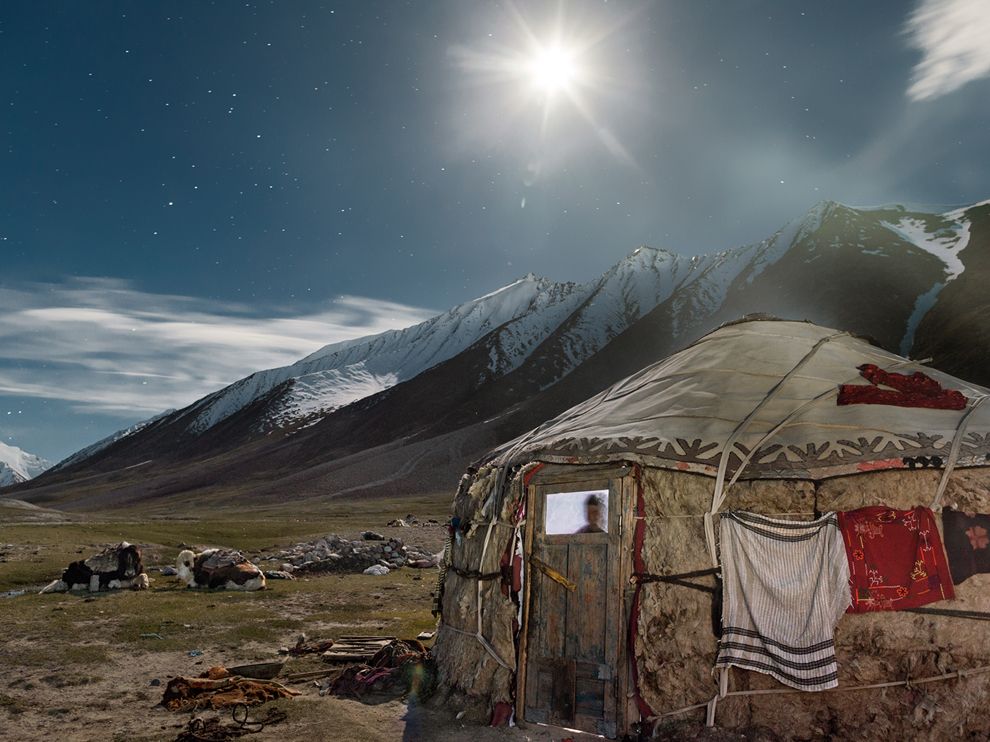
yurt
Kyrgyz Yurt, Afghanistan
Photograph by Mattieu Paley, National Geographic
Blanket-draped yaks hunker down outside a young Kyrgyz couple’s yurt on the eve of a summer trading journey. Made of interlaced poles covered with felt, these portable homes are packed up and reassembled for seasonal migration. Wooden doors are imported to the treeless plateau from lower altitudes.

Think of shelters and clothing as art. Some of them are really fine, museum quality art.

At that level each is a masterpiece of achievement. The artist –whomever he or she was –stepped up and used their creative imagination and fine skills to produce a functional and beautiful structure or fine piece of clothing. They accomplished that in spite of the fact that they were constrained by the technology and tools of the time and the materials and resources that they had at hand. Most of the materials were local, some were traded for. Each piece — each fine work of art — came into being as a result of their skill and their creativity using the materials they had available. Furthermore, each artist had a deep understanding and respect for the materials they used. Let’s look at some examples from that perspective.

Having seen them, ideally what would you like to know about each of them? The answer is simple. It would be the information provided for any piece on display at a museum. That includes:

Gun Control: A Balanced Approach

It is time to take a broader approach to gun ownership, one that recognizes the rights and responsibilities of gun owners and non-gun owners alike. Looking at the gun control problem from the perspective of an economist, I have put together a proposal that I think addresses the issues. The program is based on sound economic principles including that a role of government is to serve the public interest and not private or corporate interests. The ideas presented here protect private rights while simultaneously promoting the public interest.

Consider making the requirements for owning a gun similar to those for owning and operating a vehicle. In order to do so, the vehicle must be registered, and the driver must have a valid operator’s license. It proves that he/she has maintained the necessary qualifications required to operate a motor vehicle. Moreover, the owner pays for the operator’s license, registration fee and an annual fee that varies with the size of the vehicle. Why can’t we treat firearms in a similar way? 

Continue reading “Gun Control: A Balanced Approach”

Shelter

Thatched-Houses-Skye
Thatched roof cottage, Ireland

Rumor has it that as a species — Homo sapiens — we originated in Africa and migrated all over the globe. On a daily basis each of us requires some essential inputs like clean air, water, food, clothing, rest and shelter. See Viewing the Body as a Complex Machine. Shelter provides protection from the elements like heat and cold, the wind, rain, etc, and from daily and seasonal variation and their extremes. The nature of the protection required depended upon where we were living and on the materials that were available locally as well as the skills and tools of our ancestors. That is where our creativity as a species came into play. Using the resources that were available locally and their imagination, our ancestors created shelters to protect themselves from the elements. They were all different and beautiful. They included: Cave dwellings, TeepeesAdobes, Sod hutsThatch housesIgloos, and Log cabinsMany different structures evolved. Those are just some of them.  Aren’t they beautiful, artistic and creative? For a better understanding about what we would like to know about each of these shelters as works of art see Seeing Some Shelters and Clothing as Fine Art and Fine Craft. Continue reading “Shelter”

Variation in the Ability to Perform

thinkerFrom the time he was 10, my son, Paul, understood the relation between decision and action better than almost anyone I’ve ever known. Edie, my ex-wife, and I had just split up and I was living in what I thought would be a temporary apartment on the Parkway in Philadelphia. Paul came to visit for the first time and we were sitting on the grass in the shadow of Rodin’s The Thinker. Sad faced, Paul turned to me, “Dad, is it okay if we invite Ted?” He was Paul’s good friend who lived in Northeast Philly. “Sure,” I said. Paul lit up like a Christmas tree. A few minutes later the sad face was back again. “Okay, Paul, what is it now?” “Well, you said we could invite him!” Paul also had a fine understanding of process. He knew just what it took to get things done. Once he decided on something he went ahead and did it — until the job was complete. Again, no gap between decision and action.

Contrast that with his behavior at lunchtime. We settled in at a restaurant, menus in front of us. Sad face once again, he couldn’t decide what he wanted. My suggestions don’t help. Paul is hungry and unable to make a choice. Paul’s complex machine – we call it the body – which ordinarily has no problems making decisions and choices has broken down. Paul is very hungry. That’s the machine’s way of telling him it had been deprived of inputs and that because of that it couldn’t make decisions. It needed inputs – food – first. The human body is not always in the same, uniform steady-state condition, always ready to perform whatever tasks are required at the same level of efficiency. In order to function it requires a flow of the right inputs – water, food, rest, shelter, etc. – in the appropriate amounts over time. When it has them, it is capable of peak performance.

How often has this happened to you? You go to bed with a question on your mind. For example, you can’t remember a person’s name. In your mind’s eye you can see her face. You remember your last time together. But, for the life of you, you can’t recall her name. You fall asleep and wake up refreshed. And her name, Pat, pops up into your head. You think to yourself, “Why couldn’t I remember that last night?” If you think about it, the answer is simple. In order to be a well-functioning machine the body required one of the basic inputs — rest.

The Internal Adjustment System: A closer look

The Internal Adjustment System: A closer look

Let’s look at the body as a self-regulating machine to see how it functions to maintain body temperature. Its ability to do that is dependent upon the energy and other inputs required. They must be available. When the system is working the body is able to perform the tasks and produce the outputs required of it. As with all other mammals, a primary function – one necessary for survival – is maintaining its body temperature. For humans typically that is 98.6°F. Humans have developed a bodily system that enables it to maintain that temperature. They are able to do that in spite of considerable variation in the temperature in the external environment. Let us define what we will call the ideal external temperature. It is one that requires the body to expend the least amount of effort and energy to maintain its internal temperature. Let’s assume that it is 68°F. Any lower outside temperature requires more energy. As does any higher one to cool the body off. Continue reading “The Internal Adjustment System: A closer look”

Viewing the Body as a Complex Machine and Part of a Production Process

By recognizing that the body functions like a complex machine, one that is an integral part in the production process of any activity we engage in, it is possible to develop an improved understanding of the body’s role in the recovery process and the likely benefits and costs of any diagnostic or therapeutic intervention.

In order to survive, mammalians must able to adapt to the environment. Humans are no exception. Doing so requires getting enough pure air, clean water, food, rest, clothing and shelter to maintain their body temperature and perform other necessary functions. They must also be able to protect themselves and their offspring from the elements, any predators and poisonous or infectious agents. Survival requires being able to do that from day-to-day and year-to-year, over one cycle into the next and from one generation to the next. Survival also mandates that they adapt to changes in the physical, social and cultural environment. On a daily basis the first order of business is to provide ourselves with enough water, air, food, rest and shelter — the basic inputs — to sustain ourselves. As humans, we have developed mechanisms to help accomplish that. (See David Attenborough, The Life of Mammals)

First let us develop a clearer understanding of how the body is like a complex machine and how it is an input in any production processes of any tasks or functions we, as humans perform. From that perspective we will see how that influences the understanding of our interaction with and relationship to the health-care system. Continue reading “Viewing the Body as a Complex Machine and Part of a Production Process”

Four Generations of Changes

I lived through a period where:

  • The only way to get to Europe was on an ocean liner — like the SS Normandie — where SS stood for steamship which was coal fired. It took about five days to make the journey. The only other way passengers could get across the Atlantic was in a dirigible — a passenger zeppelin — until the Hindenberg blew up in Lakehurst, NJ in 1937. And by Pan Am’s flying boats, the Clipper Ships, that landed on water. They flew from 1939 until WWII.
  • Planes had props. There were no jets.
  • It took three days to go from New York to San Francisco — by train.
  • Sound had just come to the movies. They were in black and white, no color.
  • Speaking of black and white, there was Jim Crow.
  • Speaking of colored, the rest rooms in southern train stations were “colored” and “white”. The first time I came south it was on the Southern Crescent in 1942. When I raised the shade of my Pullman berth around Richmond, VA, and saw “White” on the side of the railroad car. I thought it was the name of the car, which at the time were named for famous people.
  • Automobiles had stick shifts. There were no automatics until the Olds Hydra-Matics in the 40s.
  • Gasoline was five gallons for a dollar.
  • There were no interstate superhighways — no I-95 just US 1 and no I-40 just Route 66. Continue reading “Four Generations of Changes”

Gun Control from an Economist’s Perspective

Firearms have the capacity to do harm to others. So along with the right to own weapons comes the responsibility to help ensure that they are not used for that purpose. There are, of course, valid reasons for using for them, like when there is a threat to one’s life, that of the members of the household or one’s property, or for hunting and recreational purposes.

The essence of this proposal is to acknowledge the right of anyone to bear arms as long as they are competent to do so. Along with that right, however, comes their role and responsibility to attempt to ensure the arms do not do harm to others and if they do, to compensate those who were injured. The following proposed program are designed to accomplish those ends.

Currently the real and financial burden of gun violence falls on those who are injured and their families, on non-gun owners, and on taxpayers. It also requires additional funding to to cover the costs of the police, other first responders and others who provide help and of the resources required to recover from the harm done by gun violence.

The proposed program has three components:

• The first is a registry that identifies all gun owners and the firearms they own and provides for a background check to ensure that they are competent to own those weapons. As a first step the flaws in the current system that make accomplishing those objective harder must be corrected.

• The second is to establish a pool to compensate those who are harmed by the illegal use of those weapons.

• The third is a gun buyback program to create the incentive for gun owners to give up their weapons, especially those that can be used in mass murders.

If no guns were in private hands there would be no need for these programs. Rather than placing the burden of the cost of gun violence on the victims and taxpayers, the objective of these programs is to transfer some of the costs to those who elect to own guns and the suppliers of firearms and their paraphernalia.The purpose is to make gun violence less likely and to compensate those who are harmed by it.

Continue reading “Gun Control from an Economist’s Perspective”